
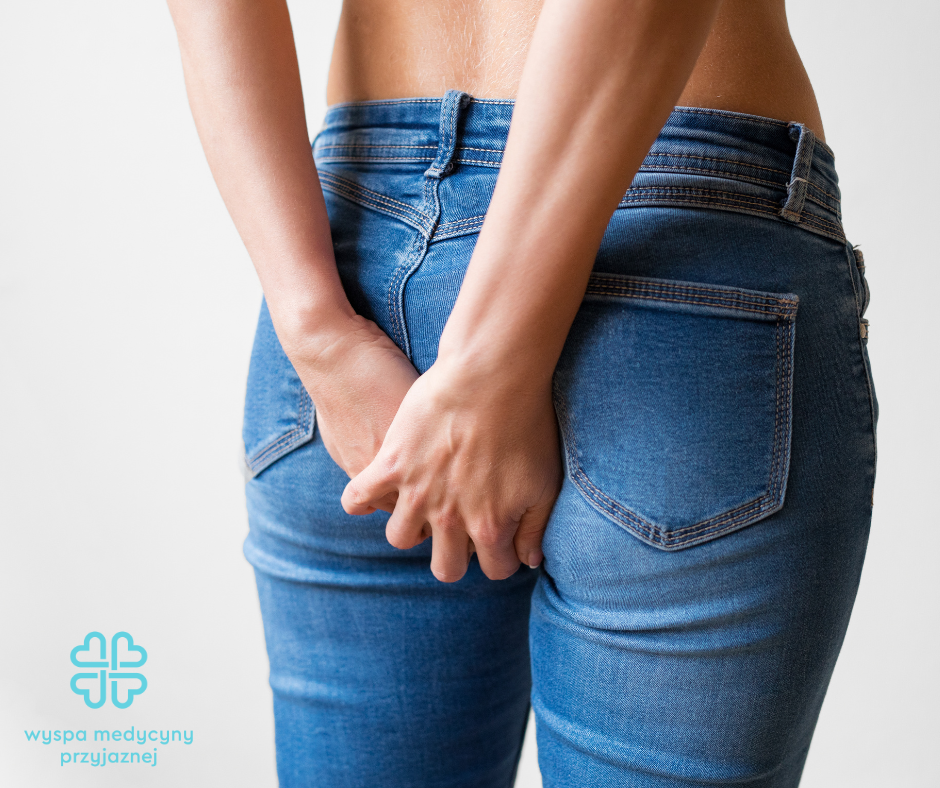
Skin folds around the anus, also called anal skin tags, anodermal folds or perianal skin folds, are usually benign changes. They do not always require treatment, but they may cause discomfort, make hygiene more difficult, contribute to irritation, and worry the patient.
In this article, we explain what anal skin tags are, why they occur, what they can be confused with, and when it is worth seeing a proctologist. If you are looking for practical information about qualification and procedural treatment, visit the service page: removal of a perianal skin tag in Gdańsk.
Author: Justyna Szul, MD, proctologist | Medical review: Kamil Smok, MD, surgeon and proctologist | Publication date: 24.06.2026 | Last updated: 24.06.2026
What are anal skin tags?
Anal skin tags are excess, soft pieces of skin around the anus. Patients often describe them as a “lump”, “piece of skin”, “fold”, “something left after a haemorrhoid”, or “something protruding near the anus”. They are usually not dangerous in themselves, but they may be a sign of a previous proctological problem.
Most often, skin folds appear after conditions that previously caused swelling, stretching, or inflammation of the tissues around the anus. When the acute problem resolves, the skin may not return completely to its previous shape, leaving an excess fold.
It is important to remember that not every “lump” near the anus is an anal skin tag. Similar-looking changes may include a thrombosed external haemorrhoid, active haemorrhoids, viral warts, inflammatory lesions, abscess, fistula, scarring after an anal fissure, or other changes requiring diagnosis. When in doubt, the safest step is a proctology consultation.
“A skin fold near the anus is often not a disease in itself. What matters is determining whether it really is only a skin tag, or whether the symptoms are caused by a fissure, haemorrhoids, inflammation, or another proctological problem.”
— Justyna Szul, MD, proctologist
Where do anal skin tags come from?
Anal skin tags may develop after various situations in which the anal area has been exposed to stretching, swelling, inflammation, or healing after micro-injuries. Often, the patient does not remember one specific moment when the fold appeared — it becomes noticeable only when it starts to interfere with hygiene or causes discomfort.
Possible causes and contributing factors include:
- previous thrombosed external haemorrhoids or swelling of external haemorrhoidal tissue,
- healing after an anal fissure, especially a chronic one,
- recurrent irritation of the skin around the anus,
- chronic constipation and excessive straining,
- frequent diarrhoea and skin irritation,
- pregnancy and vaginal childbirth,
- inflammation of the anus and perianal area,
- scarring after previous injury or procedures.
In some patients, the fold is only a remnant of an old problem. In others, it may coexist with an active condition, such as an anal fissure or symptomatic haemorrhoids. That is why the entire anal area should be assessed before deciding on removal, not only the fold itself.
What symptoms can anal skin tags cause?
Many anal skin tags cause no symptoms at all. The patient may feel them during hygiene, but if they do not hurt, bleed, grow, or interfere with daily life, they often do not require treatment.
Typical symptoms reported by patients include:
- difficulty cleaning the anal area thoroughly after a bowel movement,
- a feeling of moisture or incomplete hygiene,
- itching, burning, or skin irritation,
- chafing while walking, running, cycling, or sitting for a long time,
- discomfort with underwear or physical activity,
- recurrent redness and inflammation of the fold,
- worry that the change may be a haemorrhoid, wart, or another condition,
- psychological discomfort or embarrassment in intimate situations.
A skin tag itself usually should not cause severe pain or heavy bleeding. If such symptoms occur, another or additional cause should be looked for.
Anal skin tag, haemorrhoids or fissure — how can they be distinguished?
For the patient, different problems around the anus may look similar. A “lump” may mean a skin tag, haemorrhoid, thrombosis, wart, abscess, or a change related to an anal fissure. Differentiating them based on a photo or self-description may be unreliable.
| Problem | Typical features | What is worth doing? |
|---|---|---|
| Perianal skin tag | soft piece of skin, usually without severe pain | observation if it does not bother you; consultation if it interferes with hygiene or becomes irritated |
| Haemorrhoids | bleeding, itching, a feeling of a lump, sometimes pain when thrombosed | proctological assessment and treatment depending on disease stage |
| Anal fissure | sharp pain during bowel movements, burning, bright red blood; sometimes a sentinel tag | diagnosis and treatment of the fissure, not only removal of the tag |
| Viral warts or other skin lesions | may be multiple, uneven, grow, or bleed when irritated | they require diagnosis and different treatment than a skin tag |
If the fold appeared together with pain, bleeding, discharge, fever, grows quickly, or changes appearance, it is not worth delaying examination. In such a situation, a proctology consultation is more important than trying to diagnose yourself online.
“Patients often say: I have a haemorrhoid or I have a skin tag. Our role is to check what is truly causing the symptoms. Sometimes reassurance and hygiene are enough, and sometimes a fissure, thrombosis, inflammation, or another condition needs treatment.”
— Kamil Smok, MD, surgeon and proctologist
Does every anal skin tag need to be removed?
No. If the fold is small, does not hurt, does not become irritated, and does not interfere with hygiene, removal is usually not necessary. In such a situation, the most important steps are observation, regular bowel habits, and gentle hygiene.
Removal may be considered when:
- the fold makes hygiene difficult,
- recurrent irritation, itching, or skin maceration occurs,
- the fold is regularly irritated by underwear or physical activity,
- the patient feels clear discomfort,
- the change causes concern and requires a definite diagnosis,
- the fold is a remnant of a healed problem, not a sign of active disease.
Practical information about procedural treatment is available here: removal of a perianal skin tag.
What can be done before deciding on a procedure?
If the fold does not cause significant symptoms, the doctor may recommend conservative management. Its purpose is not to make the fold “absorb”, because excess skin usually does not disappear on its own, but to reduce irritation and improve comfort.
Helpful measures may include:
- treating constipation and avoiding excessive straining,
- adequate fluid intake and fibre in the diet,
- gentle hygiene without aggressive rubbing,
- avoiding irritating scented wipes and cosmetics,
- drying the skin after washing,
- treating itching, inflammation, or fissure if present,
- choosing looser underwear if the fold becomes chafed.
If symptoms continue to recur despite these measures, it is worth discussing with a proctologist whether the fold itself is the problem, or whether the condition that caused it is still active.
What does a proctology consultation for perianal skin folds involve?
The consultation begins with a conversation: when the patient noticed the change, whether there is pain, bleeding, itching, discharge, constipation, diarrhoea, previous haemorrhoids, fissures, or childbirth. The doctor then assesses the anal area and, if needed, performs a proctological examination.
The goals of the consultation are to:
- confirm that the change is a skin tag,
- exclude an active anal fissure, thrombosis, abscess, fistula, warts, or other lesions,
- assess whether the fold is truly responsible for the symptoms,
- determine whether the cause, such as constipation or fissure, should be treated first,
- discuss observation or procedural treatment options.
At Wyspa Medycyny Przyjaznej, proctology consultations are provided, among others, by Sara Godyńska, MD, Justyna Szul, MD, and Kamil Smok, MD.
Key information at a glance
| What are they? | excess skin folds around the anus |
| Are they dangerous? | usually not, but they may require differentiation from other conditions |
| When do they become bothersome? | when they interfere with hygiene, become irritated, itch, hurt, or cause discomfort |
| Should they always be removed? | no; asymptomatic folds often only require observation |
| Most important | active anal disease should be excluded before deciding on a procedure |
Frequently asked questions
Are skin folds around the anus dangerous?
Usually not. Most often, they are a benign remnant after swelling, fissure, thrombosis, or another previous problem. It is worth consulting a doctor if the change hurts, bleeds, grows, changes appearance, or interferes with hygiene.
Is an anal skin tag the same as a haemorrhoid?
Not always. A skin tag may be a remnant after haemorrhoids or thrombosis, but it is not the same as active haemorrhoidal disease. Differentiation requires a proctological examination.
Can a skin tag disappear on its own?
If it is a fixed excess of skin, it usually does not disappear completely on its own. However, irritation can be reduced by treating constipation, gentle hygiene, and treating conditions that irritate the anal area.
When is removal worth considering?
When the fold makes hygiene difficult, becomes irritated, causes itching, discomfort, recurrent inflammation, or clearly bothers the patient. The decision should be made after a proctology consultation.
Should a fissure or haemorrhoids be treated first?
Often yes. If the fold is associated with an active fissure, inflammation, or haemorrhoidal disease, the cause of symptoms should be assessed and treated before considering correction of the fold itself.
Where can I check the details of procedural treatment?
Details of qualification and treatment can be found here: removal of a perianal skin tag.
Does a fold near the anus make hygiene difficult or cause discomfort?
It is worth starting with a proctology consultation. The doctor will assess whether it is only a skin tag or a symptom of another problem.
Book a proctology consultation →Summary
Anal skin tags are a common and usually benign problem around the anus. They do not always need to be removed. If they do not cause symptoms, observation, gentle hygiene, and constipation prevention are often enough.
A proctology consultation is important when the fold interferes with hygiene, becomes irritated, itches, hurts, bleeds, grows, or causes concern. Before deciding on correction, it is necessary to make sure there is no active anal fissure, haemorrhoids, thrombosis, warts, abscess, or another condition requiring treatment.
The safest approach is simple: first diagnosis, then the decision whether the fold requires treatment or only observation.
Sources and medical context:
- University Hospital Zurich — Treatment of anal skin tags
- ASCRS — Anal fissure expanded information
- ASCRS — Anal fissure
- NHS — Piles / haemorrhoids
This article is for informational purposes only and does not replace a medical consultation. Diagnosis, need for treatment, and choice of method are decided by a proctologist after examination.