
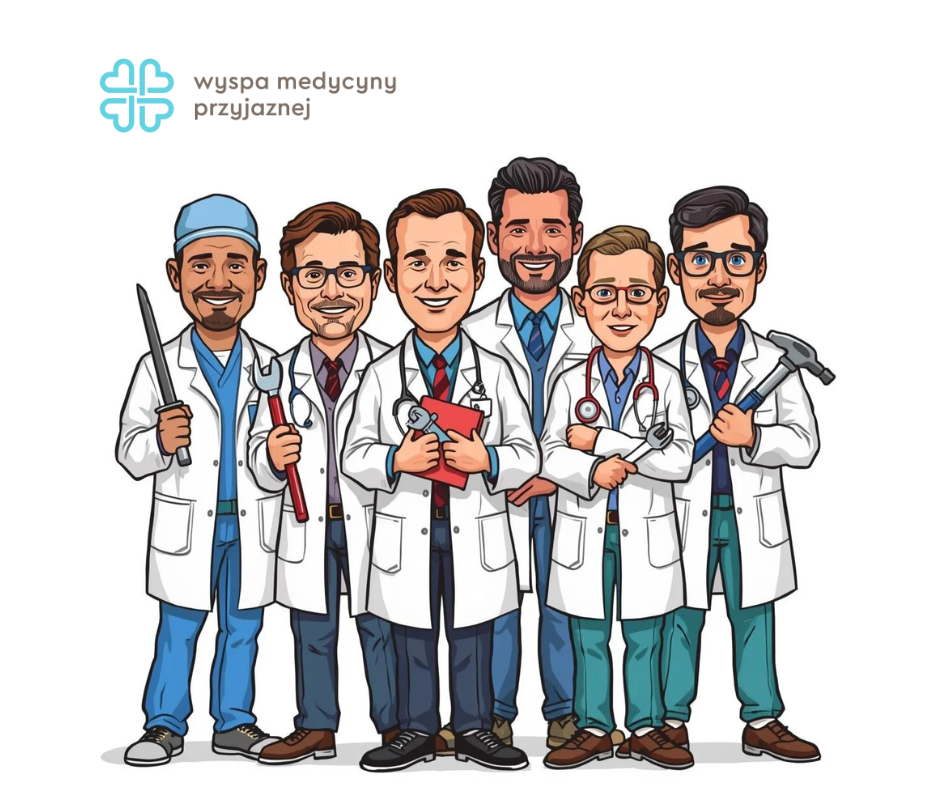
In medicine, it is easy to fall into a pattern: a surgeon sees a procedure, a dermatologist sees an ointment, a urologist sees an examination, and a proctologist sees a problem the patient is afraid to talk about. We try to begin differently — not with the procedure, but with the person who comes with fear, embarrassment, pain, uncertainty or a test result that has changed their day, week or entire life.
Wyspa Medycyny Przyjaznej was created so that private medicine could be not only effective, but also calm, understandable and human. We believe that a patient should not leave the office only with a prescription, referral or procedure date. They should leave with the feeling that someone truly listened, took them seriously and showed them the next step.
Author: Wyspa Medycyny Przyjaznej team | Medical consultation: doctors of Wyspa Medycyny Przyjaznej | Publication date: 27.06.2026 | Last updated: 27.06.2026
“If all you have is a hammer, everything looks like a nail” — but the patient is not a nail
There is an old saying: “If all you have is a hammer, everything looks like a nail.” In medicine it sounds amusing, but it carries an important warning. If a doctor looks only through the lens of their own specialty, they may too quickly suggest a solution they know well — even when the patient needs something else.
A surgeon may think about a procedure. A dermatologist about treating the skin. A urologist about urinary tract diagnostics. A proctologist about an examination the patient feels embarrassed about. A surgical oncologist about the next steps after a suspicion of cancer. This is natural, because every specialist has their own tools, knowledge and experience.
The difference lies in what they do with that knowledge. At Wyspa Medycyny Przyjaznej, we try not to start with the question: “what procedure can we perform?”, but with: “what does this patient really need?”
Sometimes the answer is a procedure. Sometimes diagnostics. Sometimes conservative treatment. Sometimes a conversation. Sometimes reassurance. And sometimes a very honest statement: “I do not see an indication for intervention.”
“Good medicine does not begin with a scalpel, laser or prescription. It begins with a conversation and understanding why the patient came, what they are afraid of and what treatment outcome will truly be good for them.”
— Piotr Rak, MD, PhD
We understand that a patient often comes not only with a disease, but also with stress
In a doctor’s office, it is rarely only about the symptom. Behind pain, a lump, bleeding, a skin lesion, an ultrasound result or a referral for biopsy, there is often something more: fear, shame, tension and a feeling of losing control.
A patient with rectal bleeding may be afraid of the proctological examination and at the same time afraid that it could be something serious. A woman going for a breast biopsy may spend several days living with one question: “is it cancer?” A man reporting a urological problem may postpone the visit for weeks because he is embarrassed to talk about intimate health. A patient diagnosed with cancer often stops hearing half of the sentences after the word “cancer” — because their head fills with noise, fear and the question: “what now?”
We understand this. That is why we do not treat the patient’s emotions as an addition to the visit. They are part of the visit. Sometimes fear needs to be named first, facts need to be organised and the plan explained before medical decisions can be made.
Proctology: we know it can be embarrassing — that is why we do everything to make it calm
Proctology is one of those fields that patients most often postpone. Not because the symptoms are mild. Quite the opposite — itching, pain, bleeding, lumps, fissure, haemorrhoids or abscess can significantly reduce quality of life. The problem is embarrassment.
A patient often comes in tense before even sitting down in the office. They worry about what the examination will look like, whether it will hurt, whether the doctor will judge them, whether it is “normal” that they waited so long. That is why in our proctology care, not only the examination itself matters, but also the way it is performed: calm explanation, patient consent, discretion and clear communication.
A proctological consultation is about more than diagnosing haemorrhoids or a fissure. It is about helping the patient stop being alone with a problem they were often too embarrassed to even name.
“Patients often say after the visit: ‘I was more afraid than I needed to be.’ That is why in proctology it is so important not to rush, to explain every stage and to give the patient a sense of control.”
— Dr Kamil Smok, surgeon and proctologist
That is why in our clinic we do not make jokes about proctological problems. We may have a sense of humour about medical myths, but never about a patient’s suffering. For us, an embarrassing problem is still a medical problem that deserves calm and professional help.
Breast biopsy: we understand the silence between the examination and the result
There are visits that patients remember for a long time. One of them is the moment when a breast lesion is suspected and a biopsy is needed. For the doctor, it is a diagnostic procedure. For the patient, it is often one of the most stressful moments in life.
We understand that a woman coming for a breast biopsy may appear calm on the outside, while experiencing enormous tension inside. She may be thinking about her children, work, family and future. She may not want to tell anyone until the result comes. She may ask very specific questions — or be unable to ask anything at all.
In such situations, the doctor’s task is not only to collect material. The doctor’s task is also to guide the patient through the procedure: to explain why the examination is being done, what it looks like, when the result will be available, what it may mean and what the next steps are.
“For the doctor, biopsy is part of diagnostics. For the patient, it is often several days of enormous tension. That is why it is important not only to perform the procedure well, but also to clearly explain what we are doing, why we are doing it and what comes next.”
— Piotr Rak, MD, PhD, surgical oncologist
We do not promise a result that does not yet exist. We do not minimise fear. We do not say “please do not stress”, because we know that usually does not help. We prefer to say: “I understand this is stressful — we will go through it step by step.”
A cancer diagnosis: the patient needs a plan, not chaos
The moment of diagnosis or suspicion of cancer is exceptional. The patient often hears the diagnosis but does not know what to do with it. They have a result, but not a map. They have the name of a disease, but not the feeling that they understand the situation.
At Wyspa Medycyny Przyjaznej, we know how important it is to guide the patient at that moment. It is not about making promises. It is about organising the path: what tests are needed, which specialist should be seen, what is urgent, what can be planned, what scenarios are possible and where the patient should be treated next.
A patient with a cancer diagnosis should not be left alone with a piece of paper and the internet. The internet can very quickly turn uncertainty into panic. A doctor should help separate facts from fear and indicate the next step.
“When cancer is suspected, the patient needs two things: truth and a plan. The truth must be given calmly, and the plan must be concrete. This greatly reduces the feeling of helplessness.”
— Piotr Rak, MD, PhD
That is why our role does not end with identifying the problem. If the situation requires further diagnostics or specialist treatment, we help the patient understand what should happen next. In medicine, sometimes the most important thing is not only “what to do”, but also “in what order”.
Urology: intimate health without shame
A visit to a urologist is difficult for many men. Patients come with problems they do not discuss with family, partners or friends. Erectile dysfunction, phimosis, short frenulum, testicular pain, penile lesions, urinary incontinence, problems with urination — these are topics that easily cause embarrassment.
Our task is to reduce that embarrassment. During a urological consultation, there are no “silly questions” or “strange symptoms”. There are medical problems that need to be calmly discussed, examined and — if necessary — treated.
“In urology, the patient often comes not only with a symptom, but also with strong resistance to talking about it. That is why the first step is to create an atmosphere in which everything can be said in normal language, without embarrassment.”
— Jakub Gondek, MD, urologist
That is why we try to speak simply. We do not hide behind medical jargon when the patient needs ordinary words. A good intimate consultation is one after which the patient feels: “Finally, someone listened and did not judge me.”
Labiaplasty and intimate procedures: aesthetics, function and enormous trust
There are procedures patients think about for months or years before booking a consultation. Labiaplasty is one of them. To someone from the outside, it may sound like an “aesthetic procedure”. For the patient, it is often connected with comfort, pain, chafing, physical activity, intercourse, childbirth, shame or a long-standing complex.
We understand that talking about the appearance and function of intimate areas requires exceptional sensitivity. The patient does not come to “fix a whim”. She comes to talk about a part of the body that affects her everyday life, sexuality, confidence and sense of femininity.
That is why in intimate procedures it is so important not to impose the doctor’s vision. One has to listen, ask about the real problem, distinguish functional indications from purely aesthetic ones, discuss possible effects and limitations. Sometimes a procedure is a good solution. Sometimes it is worth first calmly explaining anatomy, norms and natural differences.
“In intimate procedures, trust is the most important thing. The patient must feel that the doctor listens, understands her reason and does not judge. Only then can we honestly talk about treatment options.”
— Piotr Rak, MD, PhD
Surgery: sometimes the best procedure is no procedure
Surgery is associated with action. With cutting, removing, reconstructing, suturing, solving a problem “here and now”. But responsible surgery is not about operating on everything that can be operated on. It is about recognising when a procedure truly makes sense.
In our clinic, the surgeon is not there to “cut something out at all costs”. The surgeon is there to assess the lesion, risk, indications, possible benefits and possible consequences. This applies to skin lesions, lipomas, cysts, scars and aesthetic procedures alike.
Sometimes a patient comes in convinced they need surgery and leaves with a plan of observation. Sometimes the opposite happens — they underestimate a lesion that requires urgent removal or histopathological assessment. The doctor’s role is to distinguish one from the other.
“A scalpel is a tool, not a treatment philosophy. First, we need to know whether a procedure is necessary, safe and beneficial for the patient. Only then can we talk about technique.”
— Dr Kamil Smok
Dermatology: skin is not just a place for an ointment
Dermatology is often unfairly reduced to a simple pattern: “something appeared — I will get a cream”. Yet the skin is often a mirror of the whole body, immunity, hormones, allergies, lifestyle, stress and chronic disease.
A patient with a skin lesion does not always need only an ointment. Sometimes they need dermoscopy. Sometimes allergy diagnostics. Sometimes long-term treatment. Sometimes exclusion of a cancerous lesion. Sometimes reassurance that the observed lesion does not look dangerous, but should be monitored.
In dermatology, attentiveness matters. On the one hand, not every lesion should cause fear. On the other hand, a patient who says: “this lesion looks different than before” should not be dismissed. Such sentences can be the beginning of good diagnostics.
“The skin very often tells the patient’s story. Our task is not only to choose treatment, but also to understand whether the problem is local, systemic, allergic, inflammatory or requires further diagnostics.”
— Dr Katarzyna Przekazińska-Boager, dermatologist
We do not treat “cases”. We treat people at a specific moment in life
The same symptom can mean something completely different depending on the patient. Rectal bleeding in a young person with constipation may require a different diagnostic pathway than bleeding in a patient over 50 with weight loss. A skin lesion in a child, a pregnant woman and a person after oncological treatment requires a different context. An intimate problem in a patient after a first unsuccessful treatment attempt requires more conversation than in someone just starting diagnostics.
That is why we place great importance on medical history. We ask questions not to “tick boxes”. We ask because the answer can change the entire management plan. Age, medications, chronic diseases, previous surgeries, pregnancies, births, oncological treatment, alarm symptoms, the patient’s fear and expectations — all of this matters.
Friendly medicine does not mean careless medicine. It means attentive medicine. Medicine that can be gentle, but also specific. Calm, but not passive. Empathetic, but based on knowledge.
Our philosophy in practice
| Instead of... | We choose... |
|---|---|
| assuming in advance that a procedure is needed | diagnosing, talking and assessing indications first |
| minimising the patient’s embarrassment | creating an atmosphere of discretion and safety |
| using incomprehensible medical language | explaining things simply, calmly and clearly |
| leaving the patient with a result but no plan | showing the next steps in diagnostics or treatment |
| promising unrealistic outcomes | honestly explaining possibilities and limitations |
| seeing only the disease | seeing the person, their fear, context and needs |
A team that talks to each other
One of the greatest values of a multispecialty clinic is the ability to look at the patient more broadly. A symptom that brings a patient to one office may sometimes require another specialist’s opinion. A skin lesion may require a dermatologist and a surgeon. An intimate problem may involve urology, surgery and the patient’s psychosexual comfort. Rectal bleeding may require a proctologist and sometimes further gastroenterological diagnostics.
At Wyspa Medycyny Przyjaznej, we want patients not to have to arrange the medical puzzle on their own. If another consultation, additional test or referral is needed, we say so directly. We do not pretend that one specialty can answer every question.
This is what “friendly medicine” means to us: the patient is not sent away into chaos. The patient receives information on why we recommend a given step and what it is meant to clarify.
We do not like medical stiffness
Medicine is serious, but it does not have to be cold. Illness is difficult, but the doctor does not have to speak to the patient with distance and superiority. Sometimes one calm sentence, normal language or a little kind humour can reduce tension more than the most elegant office.
This does not mean that we turn everything into a joke. There are situations in which the patient needs silence, focus and very gentle guidance. There are also situations in which a light smile helps break embarrassment. Good communication means sensing the difference.
That is why the name “Wyspa Medycyny Przyjaznej” is not a marketing slogan for us. It is a commitment. Friendly medicine is medicine that does not shame, rush or frighten unnecessarily — but also does not pretend that there is no problem.
Do you have a problem you feel embarrassed about or a result that worries you?
You do not have to go through it alone. Start with a calm consultation and a conversation with a doctor.
Contact the clinic →Conclusion: we are not hammers
We are not hammers that see only nails. We are not a clinic that sees every patient as a procedure, intervention or another appointment. We are a team of doctors and people who know that the patient comes to the office with more than a symptom.
They come with a story. With tension. With questions they may be ashamed to ask. With a result they fear. With an intimate problem they have postponed for years. With pain that makes everyday life difficult. With the hope that someone will finally listen.
That is why at Wyspa Medycyny Przyjaznej we think differently. We do not start with the tool. We start with the person.
Summary
Our philosophy can be summarised simply: wise treatment is not always quick action, but it is always attentive action. Sometimes it means a procedure. Sometimes observation. Sometimes further diagnostics. Sometimes a conversation that organises fear and allows the patient to regain a sense of control.
We understand that proctology can be embarrassing. We understand the stress of a woman waiting for a breast biopsy result. We understand the patient who hears a cancer diagnosis and needs not only treatment, but also a plan. We understand the embarrassment related to intimate procedures such as labiaplasty. We understand the man who postpones a urological consultation because he fears the examination or the conversation.
And that is exactly why we created a place where medicine is professional, but also human. Specific, but calm. Modern, but not soulless. Effective, but based on trust.
Wyspa Medycyny Przyjaznej — a place where we see the person, not only the disease.
This article is informational and image-related in nature. It does not replace medical consultation. In case of worrying symptoms, pain, bleeding, a lump, suspected cancer, skin lesions or intimate problems, consult a doctor.